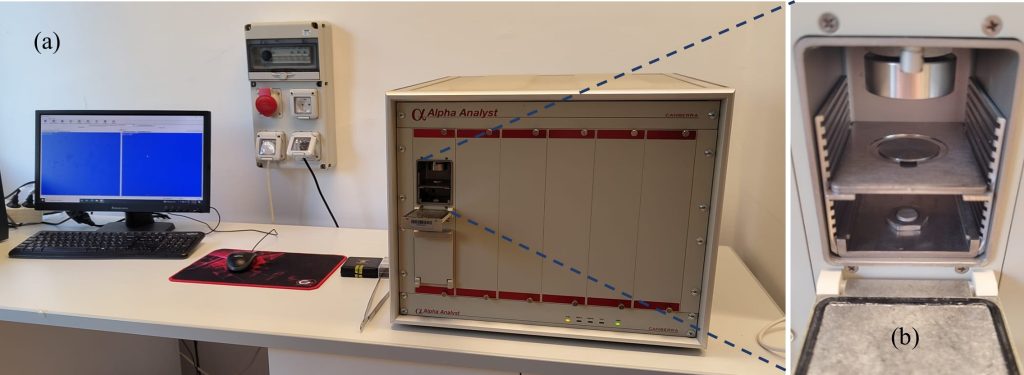
Some isotopes of chemical elements, especially the nuclei of high atomic-number atoms, can also decay by emitting alpha particles. This property can be used to determine the radioactivity of isotopes that decay by alpha emission. Alpha particles emitted by atomic nuclei with high kinetic energy (≈ 2-8 MeV) lose their kinetic energy even in very thin layers of material, so their range in solid layers is 10-100 μm, or 2-5 cm in air. Accordingly, measurements must be performed in a vacuum using special semiconductor (PIPS) detectors (Figure 1).
Since alpha spectrometry is a sensitive method for determining alpha-radioactivity, it can be used to measure small amounts (mBq) of alpha-emitting fissile material such as U, Th, Pu, etc.; therefore, it is also used as an analytical option in nuclear safeguards.
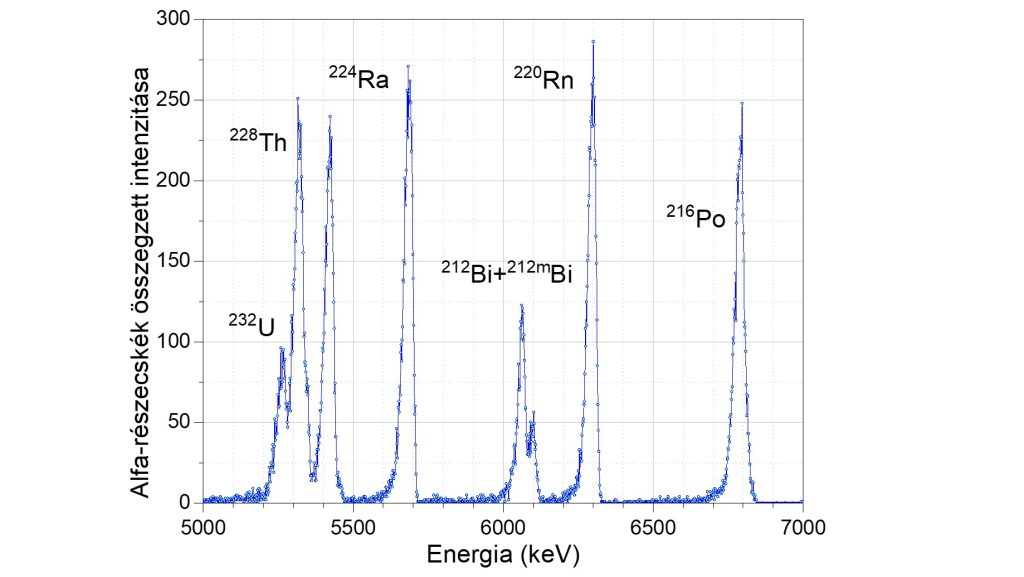
Samples suitable for alpha-spectroscopy analysis are prepared by acid digestion followed by radiochemical separation, similar to the methods used in mass spectrometry analysis. From the solutions prepared as above, a suitable alpha source can be produced by precipitation separation on the surface of a micro-filter. The complex chemical preparation aims to produce a thin sample layer whose self-absorption results in negligible loss of the kinetic energy of the alpha particles produced by nuclear decay. A typical alpha spectrum is shown in Figure 2, with that of 232U. Each alpha-decaying radionuclide appearing in the spectra belongs to the decay chain of 232U.
The alpha samples are measured using a Canberra-type alpha spectrometer (Mirion Technologies/Canberra, Alpha Analyst with Dual Alpha Spectrometer Module), which contains two alpha chambers with a PIPS detector each (Figure 1.b).