A model tested against 99 laboratory datasets offers a cooperative explanation for a long-standing low-dose radiation paradox, raising the possibility of a broader mechanism for limiting mutation accumulation
Some laboratory-grown cells respond to radiation in a counterintuitive way. At low doses, their ability to reproduce can fall unusually sharply, yet at a somewhat higher dose it can partially recover before declining again. A new mathematical model suggests that this pattern may arise because cells respond not only to their own damage, but also to damage-related signals from nearby cells.
The study by researchers at the HUN-REN Centre for Energy Research has been published in Scientific Reports.
The phenomenon is known as low-dose hyper-radiosensitivity and induced radioresistance. It has been observed in some cell lines: colony-forming survival decreases steeply at doses around 0.1 gray (Gy), then may rise between roughly 0.3 and 0.7 Gy. In these experiments, “survival” means that a cell remains able to divide repeatedly and form a colony.
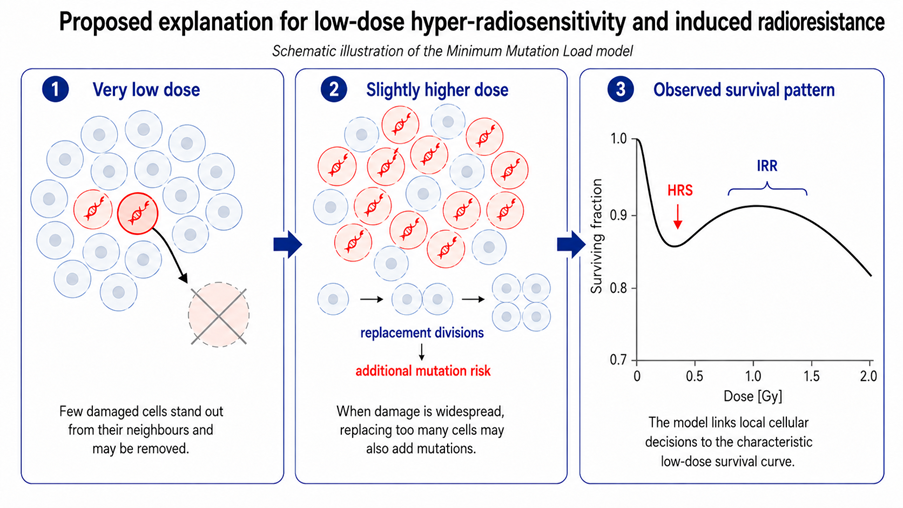
The researchers’ Minimum Mutation Load model proposes a possible reason for this behaviour. At a low dose, only a few cells may carry appreciable mutagenic damage. In the model, these cells stand out from their less-damaged neighbours and are more likely to be removed from the reproducing cell population.
As the dose increases, however, damage becomes more widespread. Eliminating every affected cell would require the remaining cells to divide more often to replace them. Because DNA replication can itself introduce mutations, excessive cell elimination may eventually create more mutations than retaining some moderately damaged cells.
The model therefore balances two risks: mutations that may arise from radiation damage, and mutations that may arise when cells divide to replace those that have been removed. Each cell’s fate depends on its own damage in relation to the damage level inferred from local signals.
The model was tested against 99 previously published clonogenic-survival datasets, drawn from 46 articles and representing 45 cell types. Across all datasets, the model achieved an average adjusted R² of 0.74, a statistical measure of agreement between predicted and observed survival. Its performance was comparable to that of the established Induced Repair model used to describe the same phenomenon.
The framework raises the possibility that the radiation response observed in these experiments reflects a more general protective process that is not specific to radiation. By selectively removing cells that are unusually damaged relative to their neighbours, such a process could help tissues limit the accumulation of mutations and genomic instability, and potentially reduce cancer risk. In this view, ionising radiation serves as a controlled way to reveal a process that could also operate in response to other forms of mutagenic stress.