Head of Department
Péter Völgyesi
Tel: +(36-1)-392-2222 ext: 2604
E-mail: volgyesi.peter@ek.hun-ren.hu
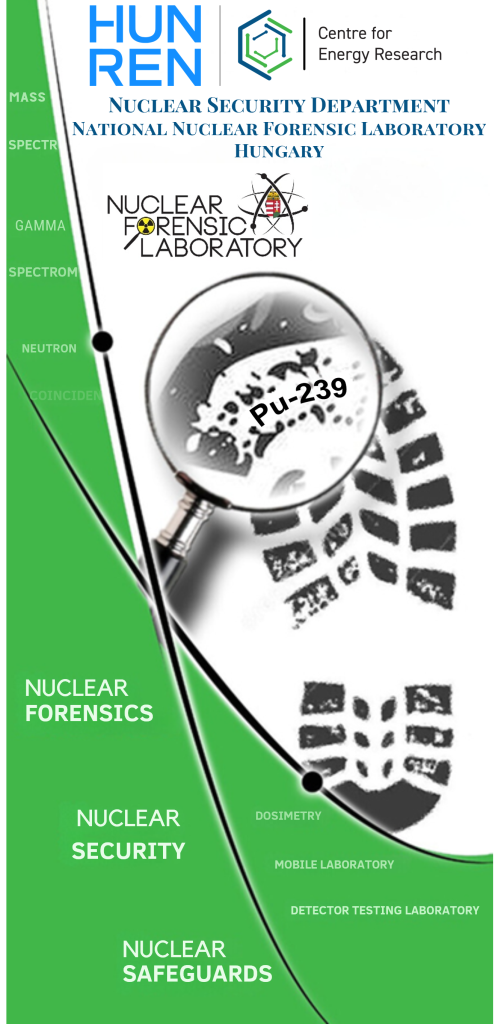
The activities of the Nuclear Security Department (NSD) encompass research and practical application in nuclear security and nuclear safeguards, as well as professional support for domestic and international organizations and private companies.
The research, method development and technical service tasks are carried out in several closely cooperating groups: non-destructive (gamma spectrometry, neutron measurement and X-ray spectrometry (XRF)), destructive (mass spectrometry and alpha spectrometry), dosimetry, instrument development, detection and mobile expert support team(MEST), detector testing and cultural heritage conservation.
One of the main activities of the NSD is to participate in combating illicit trafficking of nuclear materials and nuclear terrorism (misuse of radioactive materials) and providing scientific support to the national Stakeholders. The professional on-site analysis (categorization) of seized nuclear materials and laboratory measurements of unknown nuclear or other radioactive materials found or seized (i.e. nuclear forensic examination), is delegated to the HUN-REN Centre for Energy Research (HUN-REN EK-CER) by a Governmental Decree since 1996 (current number: 490/2015 (XII.30). The NSD maintains a mobile laboratory, a mobile expert support team (MEST), and a preparedness service to carry out the activities described by this Decree and, if necessary, to perform on-site analysis and supporting radiological crime scene management, as well as to transport nuclear materials with unknown origin to the HUN-REN EK-CER. The other task of the mobile laboratory is to support and protect major public events with its hand-held and remote radiation detection capacity. In the field of nuclear forensics, HUN-REN EK-CER was designated as a Collaborating Center of the International Atomic Energy Agency in 2016.
We operate a detector application and testing laboratory capable of evaluating radiation detectors to support nuclear security capacity building, and we have successfully participated in international projects and intercomparison exercises. Due to our extensive experience in detection capabilities and the wide range of nuclear and other radioactive materials available at our site, the NSD team works closely with radiation detector manufacturers to develop more efficient and faster radiation detectors (e.g., portal monitors and border security systems).
In recent years, a special operating procedure for radiological crime scene management has been developed in cooperation with the Criminal Forensics Department of the National Bureau of Investigation Rapid Response Police to respond to criminal or other intentional acts involving nuclear or other radioactive materials, and to support investigations at crime scenes where such materials are known or suspected to be present. Furthermore, based on a bilateral cooperation agreement, the NSD provides full preparedness support to the Counter Terrorism Centre in the event that VIPs, such as foreign ministers, visit Hungary.
A training facility, the First respOnderS cenTer at Centre for Energy Research (FOSTER), has been established to serve both national and international purposes by providing first responders and crime scene investigators with the opportunity to test and practice operating procedures using various scenario types.
The SBL holds 10-12 training programs annually for national and international first responders and nuclear experts, and typically hosts two IAEA training courses.
In the context of nuclear security, we use our internally developed Virtual Radiation Source Simulation System (VRSSS) in training activities to simulate high-activity sources (categories 2 and 3), their radiation fields, and surface contamination, interpreted as open sources. The use of such real sources for educational and training purposes would be prohibited under the ALARA (As Low As Reasonably Achievable) principle.
NSD provides scientific support for nuclear safeguards, building on decades of cooperation with the Paks Nuclear Power Plant, the Hungarian Atomic Energy Authority, and the International Atomic Energy Agency.
The NSD also supports the Hungarian nuclear industry – primarily Paks Nuclear Power Plant – through the framework of long-term cooperation in research and development related to industrial applications (e.g., burnup measurement of fuel assemblies, enrichment measurement of fresh fuel, and analysis of corrosion products). In addition, the department provides expert support and performs professional tasks to assist the Hungarian Atomic Energy Authority in fulfilling its regulatory responsibilities.
Our publications:
https://m2.mtmt.hu/gui2/?type=institutes&mode=browse&sel=institutes14025
The colleagues of the department
Péter Völgyesi – Head of Department
Emese Csipa
Judith Salupeto Dembo
Gergely Dósa
Attila Gulyás
Gabriel Iklaga
Nándor Kaposy
Péter Kirchknopf
Hedvig Éva Nagy
Ákos Rátkai
Krisztián Roland Soós
Katalin Zsuzsanna Szabó
Imre Szalóki
Davaakhuu Tserendorj
Éva Wagnerné Janeczky