One of the main activities of the Nuclear Security Department (NSD) is combating illicit trafficking of nuclear materials and the fight against nuclear terrorism. The main tasks include developing analytical methods for the analysis of nuclear materials of unknown origin and determining their origin, as well as conducting nuclear forensic examinations of radiological evidence. This activity has been ongoing for more than 25 years at our Institute. The recently updated Government Decree 490/2015 (XII.30) (previously 17/1996) delegates to HUN-REN EK-CER the duties of supporting authorities in the identification and characterization of seized and found nuclear materials of unknown origin.
In 2014, a centralized Nuclear Forensic Laboratory was established at the HUN-REN EK-CER, operated by the NSD, but also using equipment located in other departments of HUN-REN EK-CER (such as neutron tomography, scanning electron microscopy, transmission electron microscopy, infrared-spectroscopy, X-ray spectroscopy, X-ray fluorescence, etc.). Essential techniques for forensic analyses, such as gamma and mass spectrometry, can be found at our department. The primary, extensive examination of the samples, the so-called physical characterization, is performed in a glove box.
Since 2015, a prototype of the National Nuclear Forensics Library is also available at our Centre. We have ensured the preservation of the chain of custody in the case of evidence by applying our own chain-of-custody system, which is based on 11/2003 decree.
The main tasks of the Nuclear Forensic Laboratory include conducting case expert activities for the forensic examination of radiological materials at the request of the authorities, constant availability, continuous preparedness with participation at international round robin exercises and research programs, as well as organization of national and international trainings in the field.
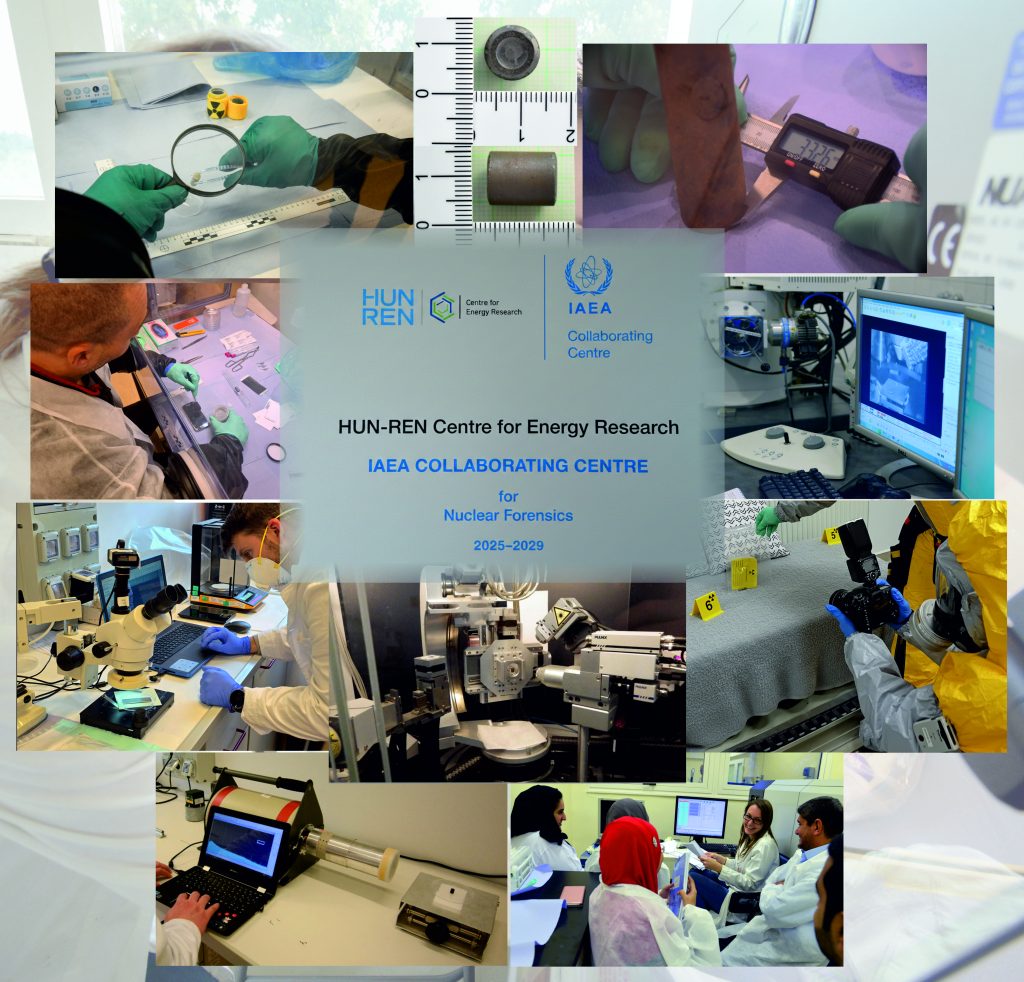
In December 2016, HUN-REN EK-CER was nominated to the Collaborating Centre of the International Atomic Energy Agency for Nuclear Forensics in Hungary – the first in the world.
The Nuclear Forensic Laboratory strives to help the East-Central European Region and other IAEA Member States in the frame of international training courses, consequently contributing to the enhancement of nuclear security at the international scale.