Budapest Research Reactor
Head of the Budapest Research Reactor: Ákos Fehér
Phone: (+36)1 392 22 22 / 1995
Email: reaktoruzem@ek.hun-ren.hu
Deputy Manager of the Budapest Research Reactor: Gergely Szabó
Deputy Manager of the Budapest Research Reactor: Ákos Danczák
The Budapest Research Reactor (BRR) is primarily used for research purposes, with its main function being neutron production. It is a tank-type reactor, moderated and cooled by light water, with a nominal thermal power of 10 MW (it is not a power-generating reactor). The BRR is operated by the HUN-REN Centre for Energy Research.
The Budapest Neutron Centre (BNC) coordinates the scientific utilization of the reactor. Together with the BNC’s facilities, the BRR constitutes one of the largest research infrastructures in Hungary and Central Europe. It supports a wide range of scientific activities in both basic and applied research, contributing to the development of a more sustainable environment.
The BRR also plays a key role in domestic medical isotope production. The isotopes produced are used in the diagnosis and treatment of cancer. Additionally, the BRR provides innovative solutions for industrial-scale isotope production.
The reactor is instrumental in the education and training of nuclear professionals. Researchers at the BNC are involved in BSc, MSc, and PhD programs at several Hungarian universities, where they teach nuclear methodologies and provide hands-on training at BNC facilities. The BNC also organizes the Central European Training School on Neutron Techniques, which combines theoretical and practical instruction. Furthermore, the BNC regularly trains international researchers delegated by the IAEA.
The BRR has gained international recognition through the scientific research conducted using its facilities. It is surrounded by 18 large-scale instruments, accessible through the International Users Program coordinated by the BNC. Both domestic and international researchers can apply for beam time. Proposals are evaluated and ranked by an international user selection panel. Applicants with the most outstanding research plans are granted free measurement time, provided the results are published in collaboration with BNC researchers.
The BNC is supported by an International Scientific Advisory Council (ISAC), composed of internationally recognized experts who advise on strategic matters to ensure high-quality operations.
The BRR is a VVR-type, Soviet-designed reactor that has been in operation since March 25, 1959. Initially operating at 2 MW using EK-10 fuel (10% ^235U), it underwent its first upgrade in 1967, increasing its power to 5 MW with new VVR-SM fuel (36% ^235U) and the installation of a beryllium reflector. A second major upgrade involved comprehensive refurbishment of all reactor components, boosting the thermal power to 10 MW and implementing significant safety enhancements. Following this, the reactor received its operating license in 1993.
According to the Hungarian Atomic Energy Authority (OAH), a periodic safety review is required every 10 years. These reviews were conducted in 2013 and 2023, and the OAH has extended the BRR’s operating license until 2033.
As part of the Russian Research Reactor Fuel Return (RRRFR) program, the BRR’s high-enriched uranium (36% ^235U) fuel was returned to Russia. Between 2009 and 2012, the reactor underwent a gradual conversion to low-enriched uranium (19.7% ^235U). Since 2013, the BRR has been operating with low-enriched uranium at a nominal power of 10 MW.
The staff of the BRR and BNC are committed to transparency and public engagement. To this end, open house events are held on the last Friday of every month. Visitors aged 16 and above are welcome to attend, provided they pre-register at reaktoruzem@ek.hun-ren.hu or useroffice@bnc.hu.
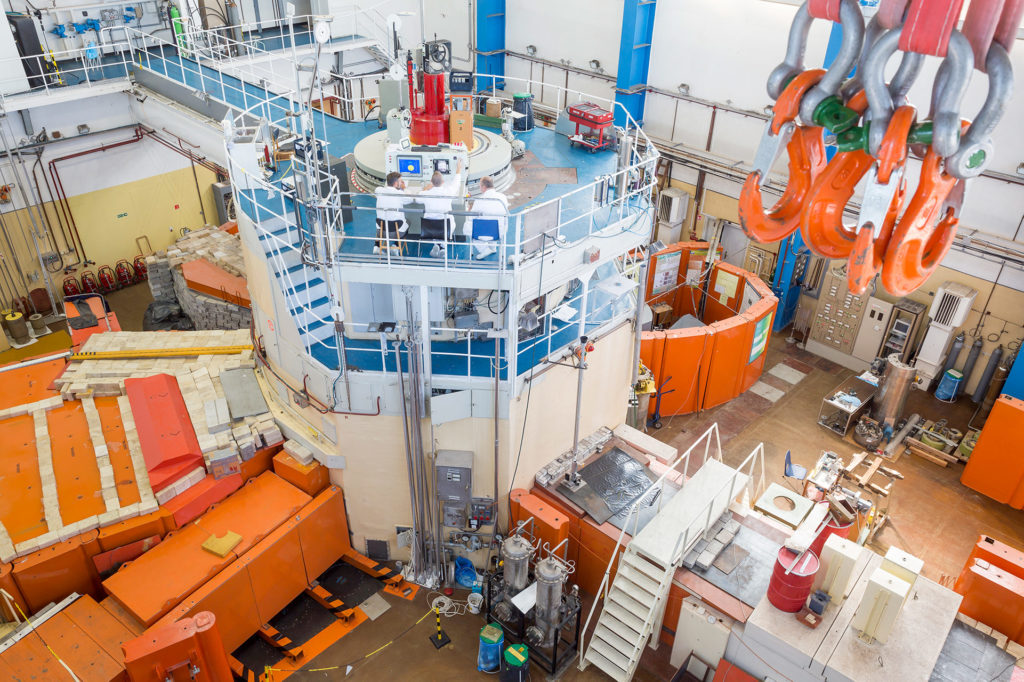
Members of BRR
Richárd Rudolf Baksa
András Balázs
Zoltán Balázs
Ádám Beihuber
Zoltán Béres
Antal Bernscherer
József Bodor
Károly Bognár
Lehet Csaba Bojti
János Ágoston Császár
Ákos Danczák
Péter Dina
Márton László Dobák
András Elter
Kristóf Fekete
István Györgyi
Tímea Heffenträger-Czibely
Balázs Máté Hellner
Péter Hermann
László Hirling
Márk Hirling
András Horváth
Sándor Janik
Domonkos Katona
Kornél Király
Andrea Koronghy-Szinek
Zsolt Lehoczki
Tibor Leitner
Albert Lővei
László Máder
Katalin Máté
István Mikoly
Ármin Pácser
Ferenc Pál
Gábor Rózsás
Pál László Sebó
Richárd Semegi
Gergely Szabó
Tamás Vörös