HUN-REN EK-CER and its Nuclear Security Department (NSD) together with the Hungarian Atomic Energy Authority operate as the Nuclear Security Support Centre of Hungary. Accordingly, SBL put a great emphasis on applied research work and prototype testing in the field of nuclear security applications. To this end, the SBL has established and operates a Detector Applications and Testing Laboratory.
The primary objective of the Detector Testing Laboratory is to monitor, evaluate, and provide expert opinion on emerging novel technologies that could have a significant impact on practical applications in nuclear security. The expertise of the Detector Testing Laboratory includes laboratory-based and in-field tests of commercial detection equipment, focusing on standard compliance testing and suitability testing for specific user applications. The standard compliance tests are supported by a wide variety of industrial, nuclear, NORM materials, and medical isotopes available at the campus. The suitability testing focuses on the user-specific operational and technical requirements of the detection systems, while facilitating discussions with end-users and hosting field trials. Prototype testing includes the completion of customized test campaigns in close cooperation with manufacturer companies, helping in preparing for standard compliance tests or tenders.
In the field of R&D, we strive to meet the needs of national and international customers, thereby supporting specialists working at the borders in the protection and exploration of radioactive sources that are outside regulatory control.
The Detector Testing Laboratory is located in a semi-basement building section of the campus at the Centre for Energy Research, Budapest. The Laboratory consists of two irradiation rooms, both equipped for different types of testing applications:
The dynamic test room is equipped with a rail-type source moving mechanism, featuring an 11 m track with adjustable speed settings from 0.01 to 2.5 m/s and source-height settings, ranging from 0 to 2.5 m. All the dynamic parameters, including speed, height, and repetition time, can be pre-programmed using a remote computer. This mobile source effectively models the conditions of a concealed source at the border. Additionally, a light beam curtain and a dosimetry monitoring system ensure safe working conditions.
The static test room consists of two irradiators, one for gamma radiation and one for neutron radiation, designed to test personal and handheld detectors. Each irradiator is equipped with lead shielding, a neutron moderator container, and a radiation source torpedo, allowing a rapid increase in the radiation field. A remote computer controls the irradiators, where the irradiation parameters, like the irradiation interval, cooling time, and repetition rate, can be pre-programmed. With this system, information can be collected on the capabilities of the detectors being tested.
The software used for controlling the dynamic and static systems is a self-developed, LabVIEW® based, modular and expandable control software. This software provides both manual and pre-programmed automated control and supervision over systems, with a wide range of operational parameters. Additionally, a weather station is mounted in the test laboratory to monitor the environmental conditions, like pressure, temperature, and humidity. This station has a portable design, a separate indoor display, and wireless communication with the control software.
The latest activity at the Detector Testing Laboratory is the R&D of pulsed radiation fields. The detection and accurate measurement of pulsed radiation fields is usually a challenge for most electronic devices used in radiation protection. Production of single pulse or repeating pulses in millisecond and microsecond ranges and response of the detectors are in the focus of the investigation.
In recent years, our laboratory has participated in a considerable number of international projects:
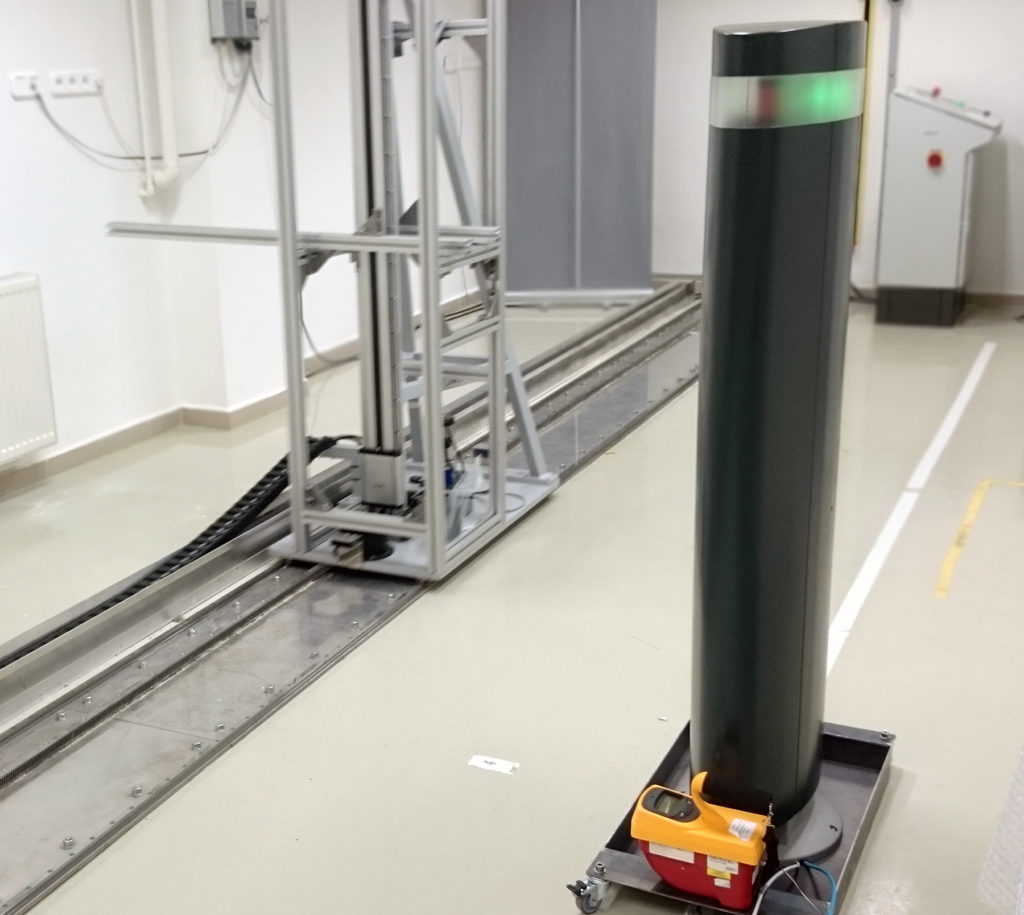
Dynamic test bed facility at EK with pedestrian SRPM (Spectroscopic Radiation Portal Monitor) detector under test
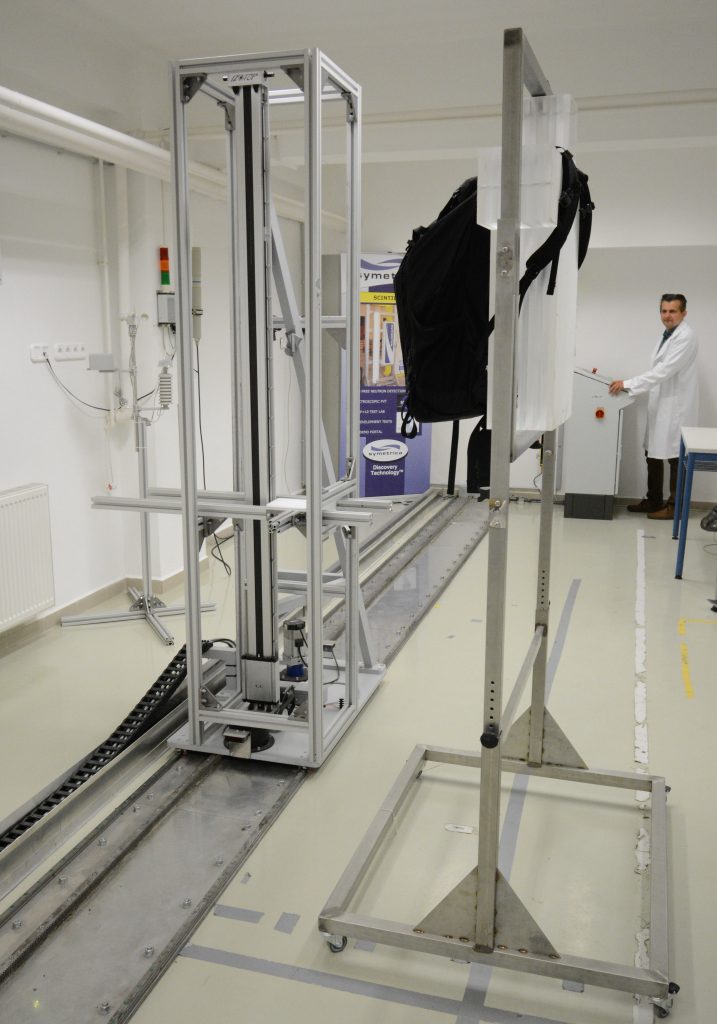
Dynamic test bed facility during “backpack” detector system testing
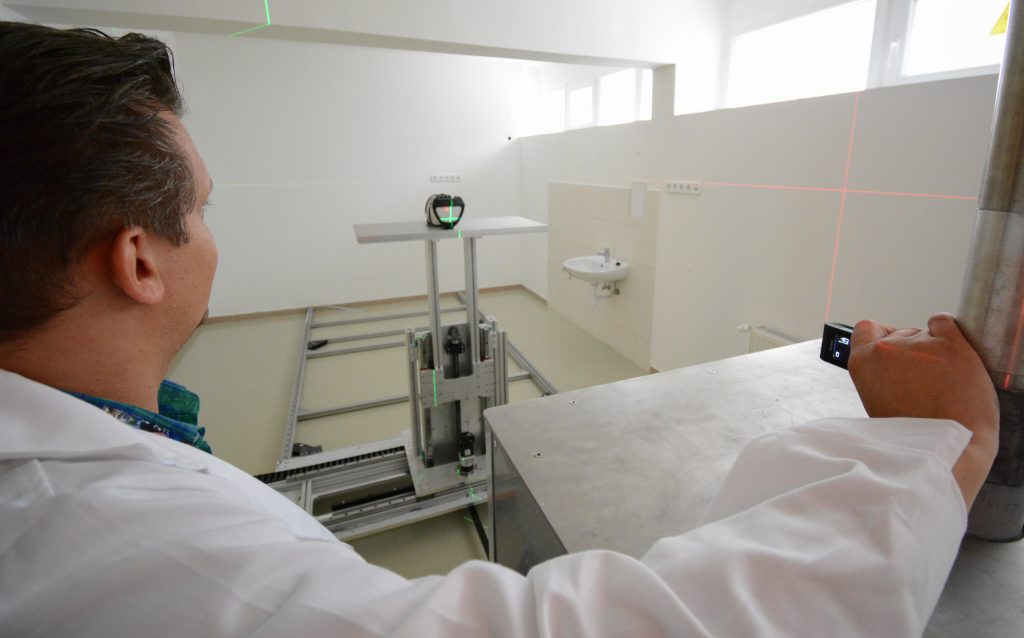
Static test bed facility at EK with RID (Radionuclide Identification Device) under test
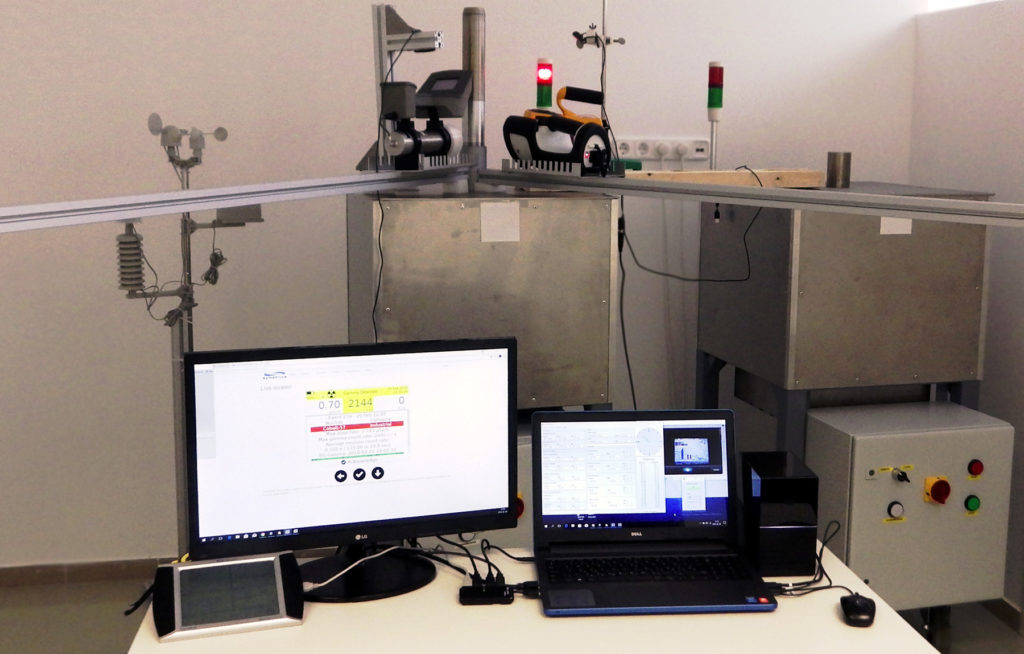
Static test bed facility at EK with RIDs (Radionuclide Identification Devices) under test