First results emerging from the new European activity for standardisation of industrial residual stress characterisation

Since the beginning of 2021, Centre for Energy Research have been engaged in the EU-project EASI-STRESS with partners from industry, academia and research and technology organisations (RTOs). Now, the results of the first measurements are becoming public. Residual stresses in metals may lead to catastrophic failures under fatigue processes and Read more

By Tamás Szabolics, ago

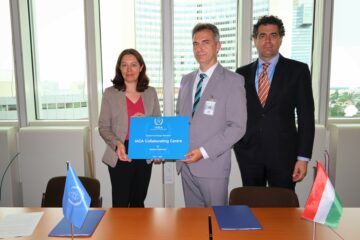
The Centre for Energy Research has been re-designated for another 4 years period as the Collaborating Centre for nuclear forensics of the International Atomic Energy Agency

The Centre for Energy Research (EK) was designated to be the first Collaborating Centre for nuclear security (nuclear forensics) of the International Atomic Energy Agency (IAEA) for 4 years in 2016. Recently, this year, the EK has been redesignated for the period of 2021 – 2025. The nomination ceremony was Read more

By Tamás Szabolics, ago

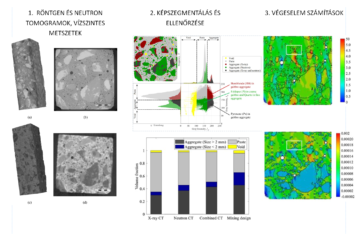
Reconstruction of concrete microstructure using complementarity of X-ray and neutron tomography

In the framework of the Visegrád Group (V4)-Korea Joint Research Program RADCON, the researchers of the Centre for Energy Research, Hungary, the Yonsei University, Seoul and the Institute of Fundamental Technological Research, Polish Academy of Sciences, Warsaw, achieved the successful reconstruction of the microstructure of concrete specimens by taking advantage Read more

By Tamás Szabolics, ago

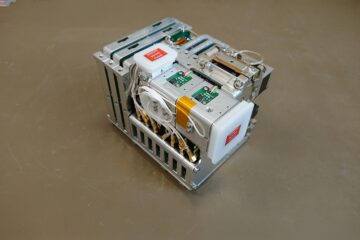
The first flight of the RadMag instrument

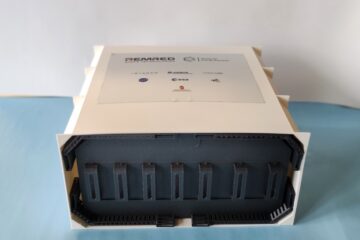
RadMag, developed by the Space Research Department, Centre for Energy Research (EK), is an instrument suite for space radiation and magnetic field measurements to study space weather. RadMag might be a key instrument to the Distributed Space weather Sensor System (D3S) of the European Space Agency (ESA) or utilized as Read more

By Tamás Szabolics, ago