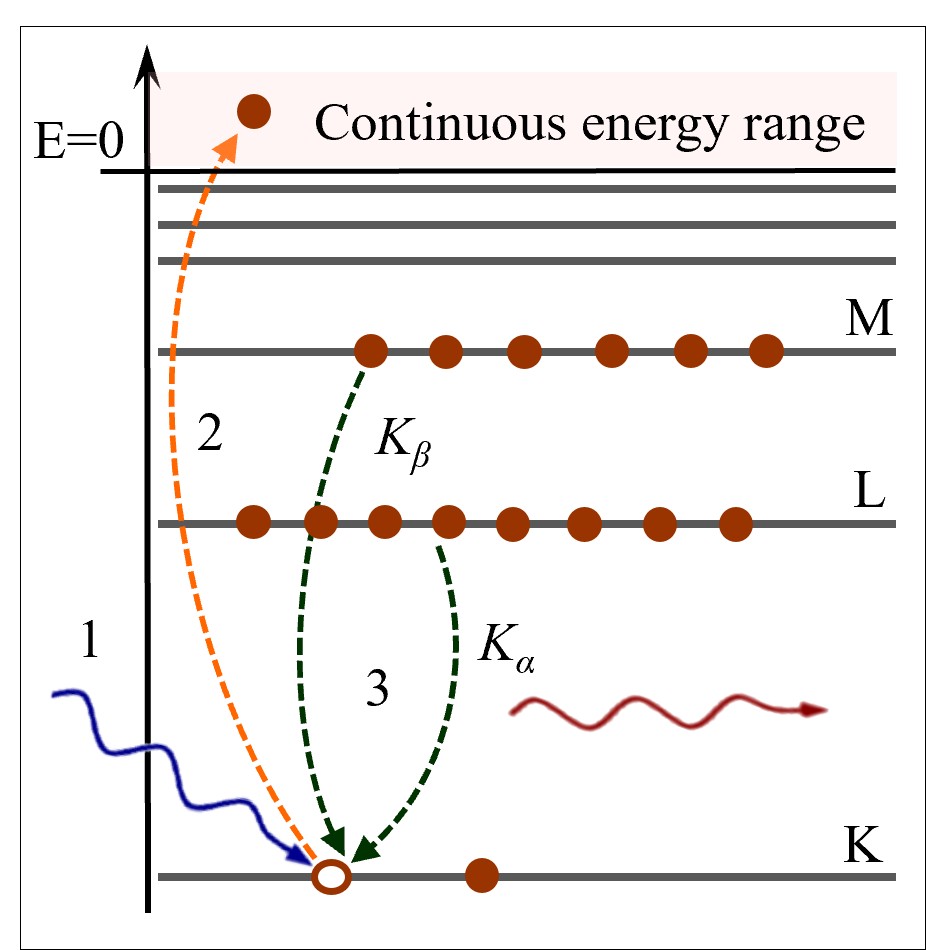
X-ray spectrometry (XRS) analysis is based on atomic physics phenomenon in which an electron vacancy is created in the electron shell of atom as a response to an externally originated ionisation event. In the following relaxation process of the atom can be completed with emission of an X-ray photon (Figure 1). The energy of the emitted photon is an individual characteristic value depending on the outcome mode of the relaxation process of the atom.
Detecting the energy of the characteristic X-ray photons produced by this method, the atomic number of the chemical elements involved in an investigated material can be determined. Basically the XRF analytical technique does not requires any destructive sample preparation and it can be applied for analysis of liquid or solid materials.
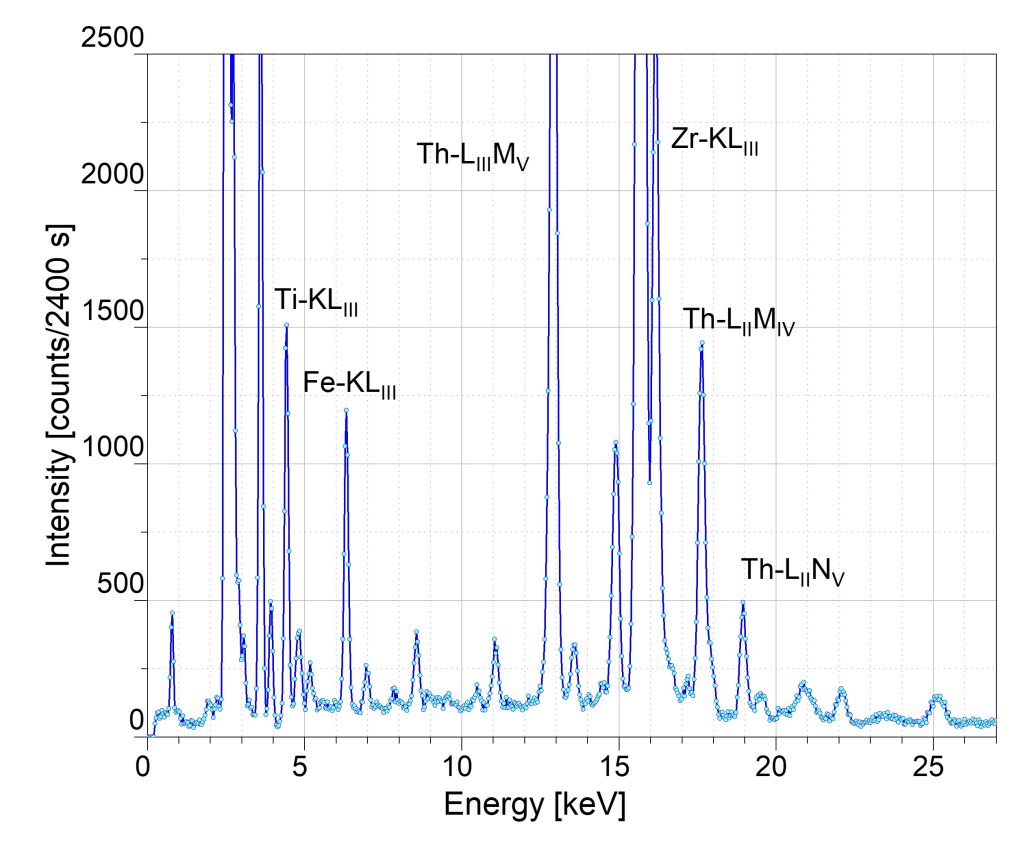
Knowing the energy of the detected X-ray photons emitted by the sample and the integral of the characteristic peaks (Figure 2) in the XRF spectrum, the relative (m/m%) amount of the chemical elements in the sample material can be calculated.
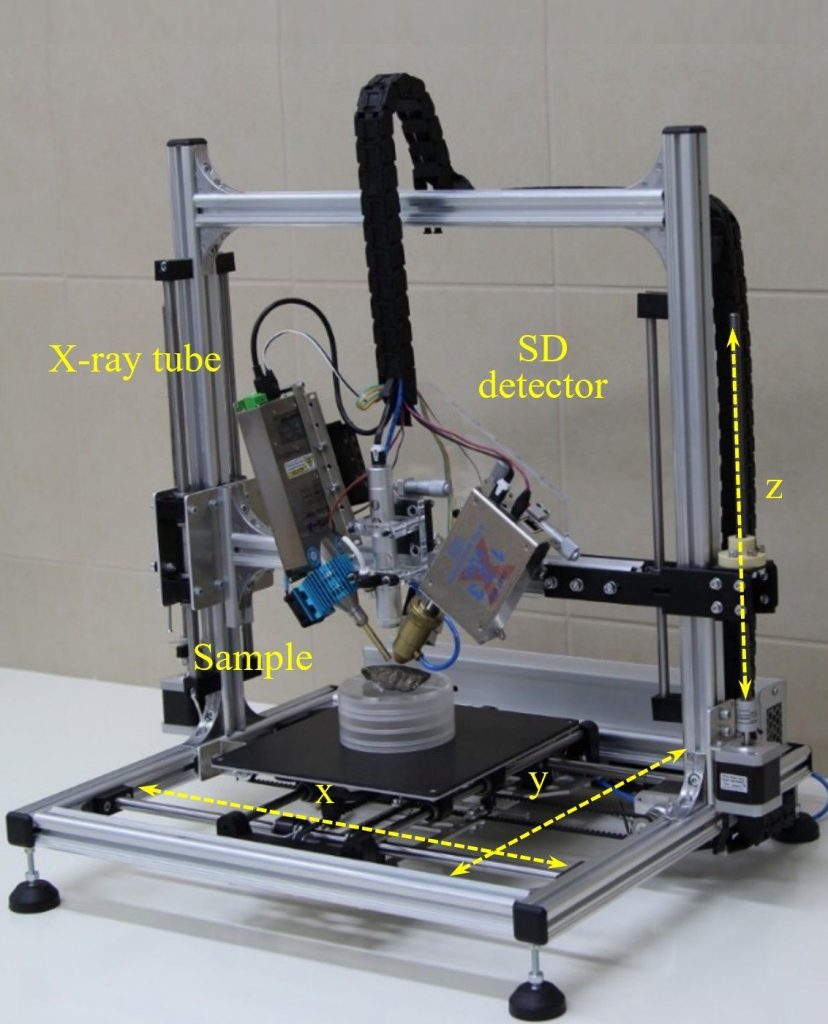
The CM-XRF (confocal macro) device is an in-house developed X-ray spectrometer including an air-cooled X-ray tube with electrical power of Pmax = 4 W (Figure 3). The anode-cathode voltage can be varied 10 – 50 kV and anode current 5 – 200 μA. The X-rays excited in the sample material are collected by a compact silicon drift detector (SDD).
The main units of the XRF spectrometer are mounted on a software-controlled moving frame, so that the X-ray tube-detector unit can be moved in the vertical (z) direction with step intervals of 0,1, 1,0 and 10 mm. The solid samples can be mounted on surface of a horizontally positioned plate, which is also movable in the (x,y) directions.
Confocal equipment allows the analysis of the composition of the sample at a focal spot of 0.5-5 mm diameter. This feature of the CM-XRF spectrometer requires precise positioning of the SDD and the excitation X-ray beam to the sample surface, supported by a built-in digital microscope and two mini laser units.
Related publications:
- I. Szalóki, A. Gerényi and G. Radócz, Confocal macro X-ray fluorescence spectrometer on commercial 3D printer, X-Ray Spectrometry, 46, 6, 497-506, 2017.
- I. Szalóki, T. Pintér, I. Szalóki, jnr., G. Radócz, A. Gerényi, A novel confocal XRF-Raman spectrometer and FPM model for analysis of solid objects and liquid substances, Journal of Analytical Atomic Spectrometry, 34, 1652, 2019.